
Elul Sermon #2
Between Beginner’s Mind and Imposter Syndrome: This is Your Judaism!
‘G’dilim ta’asu lach al arba kanfot k’sut’cha asher t’chaseh bah’ – ‘You shall make tassels on the four corners of your garment with which you cover yourself.’ (Deut. 22:12)
It’s such an odd line, wedged in between reams and reams of ethical and cultic law. Parashat Ki Teitze from Deuteronomy feels like a sequel to Parashat K’doshim, from the book of Leviticus. There are laws addressing issues of equity and justice; there are other laws maintaining patriarchy and communal cohesion. There are laws dealing with war, marriage, divorce, intransient behavior, inheritance, charity and much more. All of these are concerned with running a smooth Israelite society aligned with their understanding of the Divine Will.
And then there is this little line about making tassels for the four corners of our garments!
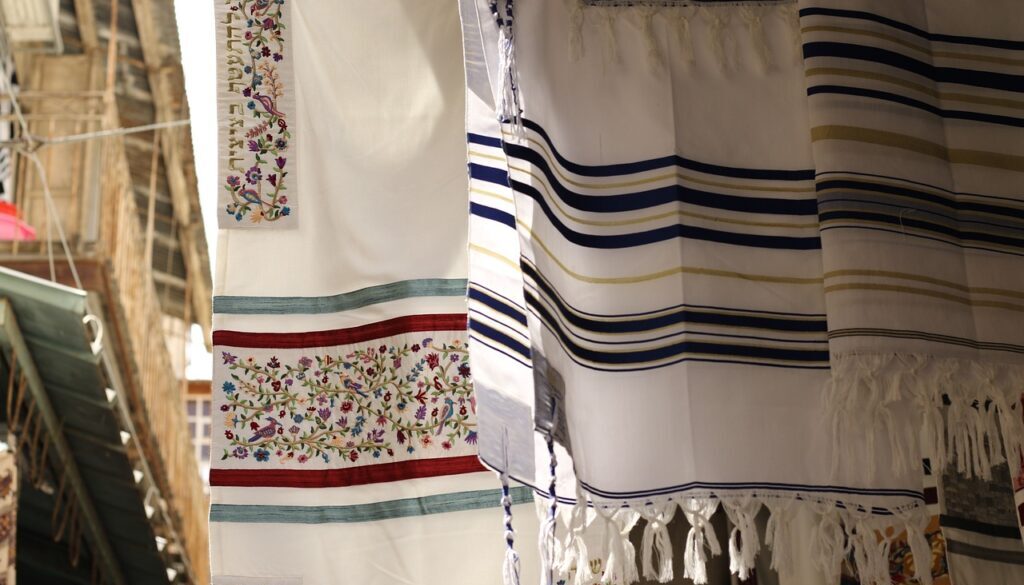
And yet, this is the very mitzvah many of us have encountered at some point in our lives: the mitzvah of tzitzit.
Rarely do any of us ‘send away the mother bird from her nest’ or ‘build parapets upon our roofs’, or especially this one: ‘not withhold the conjugal rights of a lesser-loved wife’ or ‘stone a rebellious son’ (I am resolved to *not* make any parenting jokes!). Still, the tallit is an enduring symbol of Judaism and of Jewishness – so much so that its emblematic design was taken for Israel’s flag.
There are few sights more moving than walking into a full synagogue on Kol Nidrey and seeing everyone wearing their tallitot, anticipating our holiest day of the year. The tallit is both decidedly communal as it is private; a word of opposites that are at once integrative, like the word ‘to cleave.’ The tallit cleaves us: to holy community and our Jewish people; but also cleaves us into a more private domain of personal prayer and lived experience. Each Jew has their own journey with their tallit.
I remember when I got my tallit – twenty years ago. I still use it now, for weekday prayer. It is a little threadbare and yellowed over time after years of use and washing. It is a simple, unassuming garment: black stripes on white, light and soft, made of a simple, fine wool. Not long after I bought it, a friend bought tekhelet (the blue thread) for me in Israel and I proudly tied it into my tallit. This tallit has seen a lot. I remember how nervous I was when I first bought it in the tiny little Judaica shop in Amsterdam. Dutch Judaism – especially at the time – wasn’t really all that sold on egalitarianism and I feared the judgment that my purchase may render. I remember the strong sense of impostor syndrome I felt when I put it on, my hands trembling as I made the blessing. I wore it at my first aliyah post-conversion. I wore it when I davened with a small minyan of friends on the morning of my chuppah. And during a private shacharit before my ordination as a rabbi, I wore it too. My tallit has journeyed far and wide; from Jerusalem to the Arctic Circle, from Havana, Cuba to a rising new Berlin, my prayers a resilient defiance of history. I have laughed, praised and wept wearing it. ‘Ta’aseh lach al arba kanfot…’ make for yourself on the corners of your garment…
But I want to revisit something quick. Earlier, I described ‘everyone’ wearing their tallit during Kol Nidrey. But I purposely deceived you. Of course it is not true: not ‘everyone’ wears a tallit. Nor does ‘everyone’ have to. First of all, you should only wear a tallit if you want to and feel comfortable and empowered to do so. But here’s a hard reality: many people do not wear a tallit because of impostor syndrome; because they somehow do not feel worthy to this most universal of mitzvot.
Firstly, there’s the, ugh, gender stuff. I would hope we would have resolved that by now, but we haven’t. Twenty years ago, I also struggled with its gendered implications despite my rational commitment to egalitarianism. Sometimes norms and expectations settle deep in the kishkes, where they stay lodged against our better instincts. Of course, no woman should be compelled or forced to wear a tallit – but neither should a woman deprive herself of the right bequeathed by her by our great tradition to wear one. So if you are a woman and you have not yet worn a tallit, I wholehearted invite and support you to do so. (Come talk to me sometime!)
Secondly, there’s the ‘religious’ stuff. Do you have to be a particular kind of Jew to wear a tallit? And by ‘particular kind’ we mean the fully observant, God-fearing (to use that awful word) type? In other words, do you have to be ‘frum’? These expectations too settle deep within us and we must be firm in our answer: no. Any Jew can wear a tallit. There’s no purity test or any kind of test. Just a gentle, loving invitation from the Torah to engage with this mitzvah. If you are a secular Jew or a skeptical Jew, a doubting Jew or an ‘I’m-angry-with-God’ kind of Jew: wear your tallit. Wear it as an act of devotion or as an act of protest. Wear it as an ethnic marker or a tribal identifier. Wear it as a pronouncement of solidarity to your ancestors or for your descendants. Wear it as a Jew-by-birth or a Jew-by-rebirth. There is no Tzitzit Police: this mitzvah is yours.
Which brings me to my last point. During the year, we can already feel the stymying effects of impostor syndrome. But during Elul and the High Holiday season, our sense of inadequacy can feel weaponized against us by the heaviness and inevitability of the Hebrew calendar. We feel crippled at times by this season, searching for a way in or perhaps a way out, but a way forward to be sure. Set aside your impostor syndrome. So many of us had it and have it, including rabbis—including me. Set aside your self-judgment and the policing of your neshamah, your soul. Instead, swap out the paralyzing with the liberating. Replace imposter syndrome with beginner’s mind. Know that you can come to each mitzvah, each tradition, each idea, with freshness, hope and curiosity, with childlike wonder and unending delight. Celebrate what you do not yet know and take pride in what you have made your own.
This Torah, my brothers, sisters, siblings, was given to all of us and for all of us. This Torah is not an iron chain but a golden thread. It is not recrimination but invitation. Consider your worth this Elul as being made in the Image of the Divine and infinitely loved by God, Who years for our t’shuvah, our return to who we were meant to be. If you are already wearing a tallit: relish it, nurture it, let it nourish you. And if you do not yet wear one and would like to: you are cordially invited. I am here to help you every step of the way.