
The Dark Heart of Power
The cruelty and mystery of Leviticus 18:22 and 20:1 cannot be understated. Embedded among cultic taboos circumscribing forbidden intimate relations in Parashat Acharei Mot, and juxtaposed with verses exhorting ethical conduct in K’doshim, stands the prohibition against ‘offering up offspring to Molekh’. The image is horrifically dystopian and brought into greater detail in other parts of Scripture. Deuteronomy adds the prohibition to not pass children ‘through the fire’ and the Book of Kings (1 Kings 11:7) describes how even the wise King Solomon permitted his many wives to build shrines to the pagan gods, including Molekh. The Jewish concept of ‘Hell’ (debatable though it may be) was inspired by Gehinnom, the valley in Jerusalem where child sacrifice was practiced. While archeologists, historians and Biblical scholars may differ to what extent human sacrifice was practiced in the ancient world, there does seem to be consensus that it did occur. A fictional account would be horrific enough; to think that this account may be based in fact is dizzying in its nihilism.
What could lead human beings to murder their own children in worship of an idol? Idolatry as a principle is hard to grasp for us pluralistically-minded moderns. I suspect many of us are not vested in policing other people’s belief systems and part of me is utterly unconcerned with whether people worship one God, no God or many gods. Paraphrasing the old joke: monotheism is the worship of one God too many.
In this sense, idolatry is an at best unhelpful and at worst, deeply offensive categorization of other people’s belief system. This is not to say that I do not believe there are philosophical merits to the monotheist argument, but it is far better to define merits by what they are instead of by what they are not.
Hence, we are left to struggle, as modern, liberal, pluralist Jews, with the implications of idolatry and the meaning of why our tradition seems to condemn it outright. It is exactly these verses of Leviticus, speaking of the death cult of Molekh, that allows us to not just see the ultimate consequence of idolatry, but to understand the beating of this heart of darkness. The clue to this cruel and mysterious verse lies in our interpretation of the god’s name: Molekh.
While the root mem-lamed-kaf simply means ‘king’ or ‘royal’ in both Hebrew and other ancient Semitic languages, in this case the vowelization is surprising. We would expect Melekh to be vowelized as well, the word ‘melekh’, king. Instead, Hebrew Scripture seems to favor Molekh. A famous homilectical interpretation is that Molekh is an intentional vowelization meant to deliver a sharp and offensive critique: adopting the vowels of the Hebrew word ‘boshet’ and transplanting them into the word ‘melekh’. ‘Boshet’ means ‘shame’.
At the heart of this cruel, cultish, absolutist idolatry lies a deep, pervasive shame.
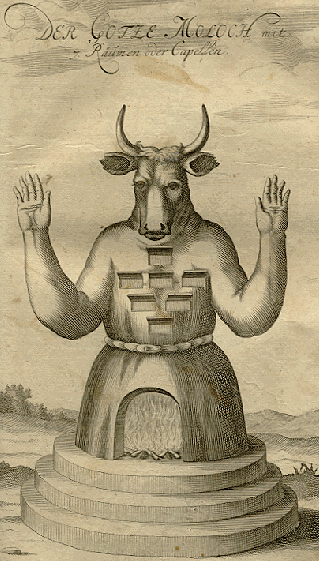
Rabbinic texts elaborate on what other extant historical texts attempt to describe: the cult of Molekh, where worshipers would erect a hollow bronze statue of a humanoid bovine and stoke fires within it, rendering it red hot. The statue would have outstretched arms, sloping in some descriptions, and upon these, an infant or a child would be placed—either resigned to instant immolation or falling into the flames at the feet of the idol. It is a barbaric and horrifying image. In the Rabbinic elaboration, the idol is large enough to accommodate seven inner chambers in which offerings of increasing value and importance would be offered: from turtle doves, to sheep, to oxen to, ultimately, a human child. What is so powerful about this particular image is the incrementalism of its cruelty. The slippery-slope of despair and dehumanization that leads to some humans to offer up other humans in sacrifice. Drums would be beaten and instruments played in order to drown out the wailing of bereft parents as their children were ‘passed through the fire.’
The question that hangs in the air is why. Why would anyone engage in human sacrifice? The answer I present here is not historical or anthropological but existential. The Jewish tradition grapples with the same question. The Sifrei (a body of Midrash) on the Deuteronomy text describing the cult of Molekh, cites Rabbi Chanina bar Antignos. Rabbi Chanina states that the god is called Molekh because the idolaters would elevate anything they made, to rule over them, ‘even a splinter, even a pebble.’ Ibn Ezra brings a similar explanation, citing Tractate Sanhedrin 64a. According to this interpretation, it refers to anything that is ‘set on a throne to rule over’ someone.
The abomination of this particular idolatry is not metaphysical. It is the ultimate consequence of unrestrained materialism. It is not a continuum ranging from the One True God to myriads of untested, false ones, but rather a continuum stretching from the sacred priority of human life to the corrupted obsession of possession above all else. In the Biblical mind, idolatry is not merely a violation of the terms of the covenant. It is placing priority in what is man-made, which, in the words of Psalm 116, ‘have eyes that cannot see, ears that cannot hear, hands that cannot make.’
Our response is intuitive: abject and absolute moral indignation. Does not every parent love their child? Should it not be clear, a priori, that there is no higher value that human life itself? Trying to imagine why the ancients would commit such heinous act as consigning the very young and vulnerable to the flames seems near impossible. Surely, we are inclined to believe, that with the relentless march of modernity, such cruel practices have been eliminated. Nowadays, between ethical individual values and societal norms enshrined in law, from criminal codes to United Nations charters, would certainly circumscribe such cruelties.
Perhaps that is exactly why the prohibition in Vayikra is embedded between the arayot (the sexual prohibitions) and the Holiness Code (interpersonal ethical injunctions). Balanced between private behavior that is unseen and communal behavior that is held to collective account, the Torah understands the darkness of the soul deeply. When unchecked by either individual morality or by conscious and compassionate legislation, each and every one of us holds within us the smoldering embers on which we could ignite fires for Molekh. When we place possession, greed, financial interest, ambition over the concern for the living, then we are prostrating ourselves before Molekh. Molekh is not a deity of measured and righteous governance, it is a god of shameful and shameless power. It is the ultimate consequence of accepting the dominion of our materialism.
This curse is as contemporary as it is ancient. The God of Israel is clear: we are to uproot such idolatry from our hearts and from our world. At every turn, without compromise, we are charged to ask ourselves: will we pass our children through the fire? The elderly? The poor? The vulnerable? People of color? Essential workers? Doctors and nurses? As the economy dives into free fall and as we face the real-life implications of our current predicament, Judaism intentionally calls us to abide by an impossible bar. We will not settle for any less than the preservation and dignity of all human life. And we will anchor ourselves, not in the heart of darkness, but in the heart of Torah: that we shall love our neighbor as ourselves.
‘ki ani Adonai’. For Adonai is the seal of that very truth.