Two Brothers and An Angel – Reflections on Jewish Communal Divisions on Israel/Palestine
For the last eight years since I’ve been a Midwestern rabbi, I’ve stood by the premise that ‘the periphery is the cutting-edge.’ What I mean by this is that social innovation can happen in unexpected places, not despite their limitations but because of them. When you live in a place like ours where Judaism is not to be taken for granted, you live away from the glare and are able to see more opportunities to bring a new Judaism to the fore.
I’ve seen this in our small community time and again, often in quiet and subtle but still structural ways. I’ve seen it in how we strive to make strides in matters of inclusivity, whether it is on LGBTQ issues, interfaith experiences or conversion. I’ve seen it in how we interact with our neighbors: being well-integrated into the wider community means that we are able to develop a closeness with people of other backgrounds and civic institutions. And I’ve seen it in how we have navigated Jewish communal conflicts around Israel/Palestine.
This is not to say that we get it all right or that there is no disagreement or tensions. We Midwestern Jews are human, just like any other humans. But ‘the periphery is the cutting-edge’ can mean that we find modes of existence and coexistence here locally that can be a model. As a one-synagogue town, our commitment to build a wide tent has led to creativity and sensitivity in our programming, ritual and intellectual discourse. It helps us stay the course of our humanitarian commitments and shared project of holy community, irrespective of our personal attachments or ideologies to the Middle East.
Sometimes, being more ‘peripheral’ as a community allows us to seek shelter from the stormy and bruising discourse that plays out on the national stage. As I have gotten older, I have appreciated the practice and discipline of quietude, of ‘waiting-to-see’. There is a discernment between what is urgent and what is important, and if it is truly important, then taking a moment to breathe, think and consider is very much worth it.
I purposely have not preached on Israel/Palestine for a while. I think each of us – myself included – needed a break from the heaviness of the world and the hurt of these last two years. I acknowledge this is a privilege and luxury, of course. The peoples of the region cannot afford to ‘take a break’. However, as a rabbi and community organizer, I also know that true and continued efforts towards coexistence and repair require moments for us to breathe and process. We cannot run on fumes.
At the same time, the situation in both the West Bank and Gaza is deteriorating. There continues to be simmering violence and much deprivation. There are unanswered questions about how the Gaza Strip is being carved up limb by limb, what the future of Gaza and the sovereignty of its people will look like. There is turmoil about the state of Israeli politics. There is continued escalation of settler violence on the West Bank. I cannot imagine how deep and raw the trauma remains for Palestinians and Israelis alike. While this sermon does not seek to provide a political analysis, it does seek to tenderly remind us: this situation isn’t over—we still live in a time of moral emergency.
Superimposed on this story is the national story of American Jewish strife and anxiety. This plays out in conferences and social media accounts, in opinion pieces and surveys. Our community is deeply divided and recent events such as the election of Mayor-Elect Zohran Mamdani in New York have provided a focal point for such tension and conflict. I have sat back and watched some of this unfurl, holding disparate truths and realities side-by-side; the horrors of the Middle East and the meta-narrative of the state of affairs of the American Jewish condition. We are alive at a moment where Jewish mainstream institutions remain firmly ensconced in their positions, while 30% of New York Jews voted for a political candidate criticized by those same institutions and 40% of American Jews believe Israel has committed genocide in Gaza (and a larger 61% believe Israel’s actions constitute ‘war crimes’, according to a recent poll of the Washington Post). Equally true, a majority of American Jews feel an emotional connection to Israel as a country and society.
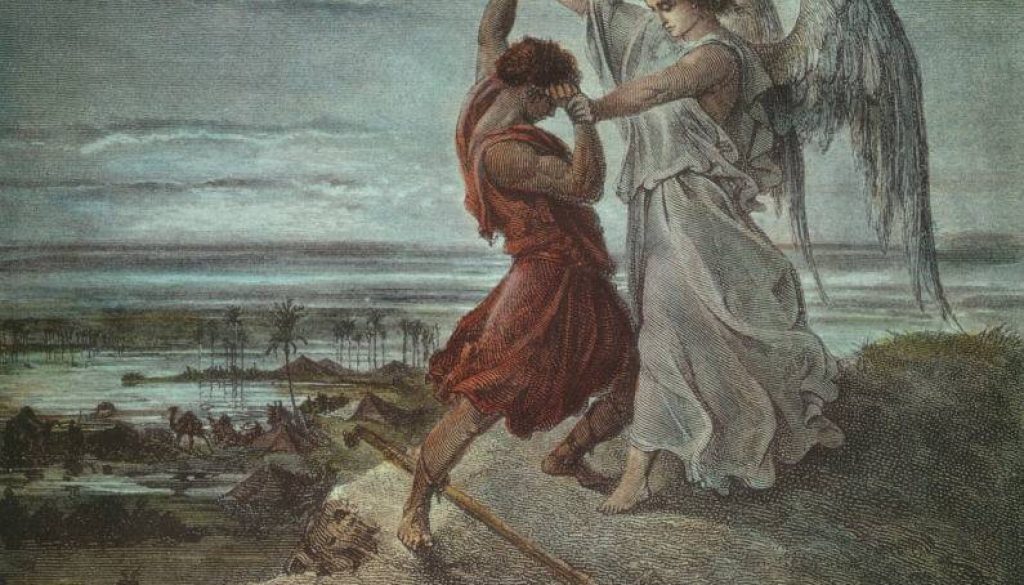
To be clear: I am not giving this sermon to arbitrate, but rather to illustrate. What does it mean to be so divided? To feel more heat rather than light generated by these superimposed conflicts? To witness these developments against the backdrop of rising antisemitism in this country and a shifting narrative on both the political right and left? It is a lot, and for any thinking Jew, it is hard to feel our way through the morass. At the base of it all, perhaps, dwell questions of our safety and unity as an American Jewish community. I cannot provide an answer to those questions in one small sermon, but can create space for us to wrestle with these very questions. After all, Yisrael means God-wrestlers; just like our forefather Jacob wrestled with the Angel on the banks of the river Jabbok.
Shaul Magid, a rabbi, scholar and Visiting Professor of Modern Jewish Studies at Harvard Divinity School, and Distinguished Fellow in Jewish Studies at Dartmouth College, attempts to invite us to wrestle with the dark angels of the Jewish future. In one of his more recent Substack articles, he prompts us with a series of provocative questions. The premise of his piece is that we as American Jews should not be afraid of divisions, or as he calls them, ‘schisms.’ Schisms are endemic to Jewish history; the mythos of the twelve tribes is already founded on it. We have seen schisms between Sadducees and Pharisees, between Karaites and Rabbanites and between Hasidim and Mitnagdim, to mention a few. Schisms in Magid’s reckoning, are opportunities for clarification and growth. Just like Esau and Jacob needed to individuate away from each other before they could reconcile, perhaps so too we should not be afraid of the sacred power of communal disagreement.
Shaul Magid asks provocatively:
“For example, is Israel truly the state of the Jewish people, or only those Jews who support it? Can American Jewry truly make space for non- or anti-Zionism even in a space where Zionism dominates? That is, can American Zionism abandon its hegemonic grip on American Jews? And if it cannot, what will it do with a growing young generation of Jews who choose not to be Zionists after Gaza? Will American Jewry split into two ideologically opposed factions/sects on the question of Israel as the Holocaust looms less and less large in the Jewish psyche? Will non- or anti-Zionist Jews be allowed entry into rabbinical schools or Jewish institutions? Will Israel and America Jewry part ways? Will pro-Israelist American Jews move to Israel in appreciable enough numbers to weaken their influence in American Jewry?”
Each of these alone merits a chapter in an academic journal or a two-hour discussion at a Kiddush lunch. We sit with the questions just as we sit with the tensions, but are comforted by the historical perspective that Jews have wrestled in ages before and will continue to wrestle along as our Judaic civilization exists.
This week’s Parashah is a consequential one. Ya’acov becomes Yisra’el, coming into the fullness of his own being and the ability to both look his brother in the eye and himself. Paradoxically, perhaps, there is a ‘shleimut’, a wholeness, in the split. The word ‘devekut’, like its English counterpart, ‘cleaving’, can mean both to split and to bring together. This week’s Parashah also invites us to ask honest questions about Jewish powerlessness and Jewish power, as Dina is raped and her brothers Shimon and Levi ethnically cleanse the Shechemites in revenge. This week’s Parashah also speaks to our deepest fears and losses, as Rachel perishes bringing Benjamin into the world, inviting us to think what futures are born upon the ashes of what is no more. And of course, each one of these merits a sermon.
We will end these deep thoughts on a ‘nechemta’, a comfort. Challenge is productive, the way peripheries are cutting-edges. We change and adapt and innovate in unexpected ways under unpredictable circumstances. Perhaps the lesson is knowing when to pick the hour for the wrestling (under the cover of night? After meditation and reflection?) and when to set the time for reconciliation (under the glare of the moon that allows us to see the soul in the other’s eyes?).
We still live the story and the promise of two brothers and an angel. In our small corner of the Jewish world, we will keep on wrestling, on our terms, with our love and strength for each other. I am glad I get to wrestle alongside with you.